
The Obseria observability architecture
Six layers, one context: OpenTelemetry-native ingestion, a stream pipeline, an index-free lakehouse, automatic topology, AI and automation on top.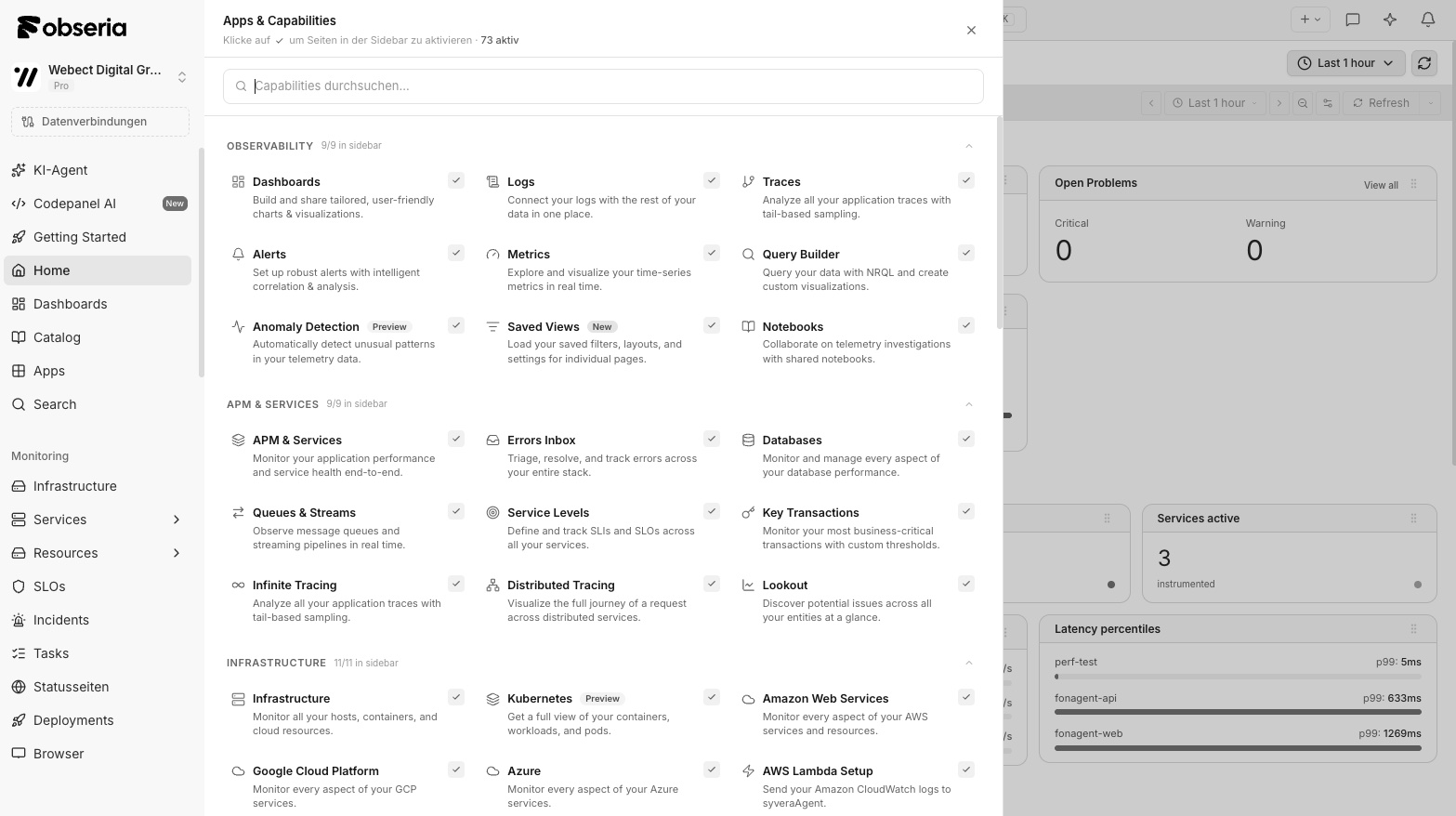
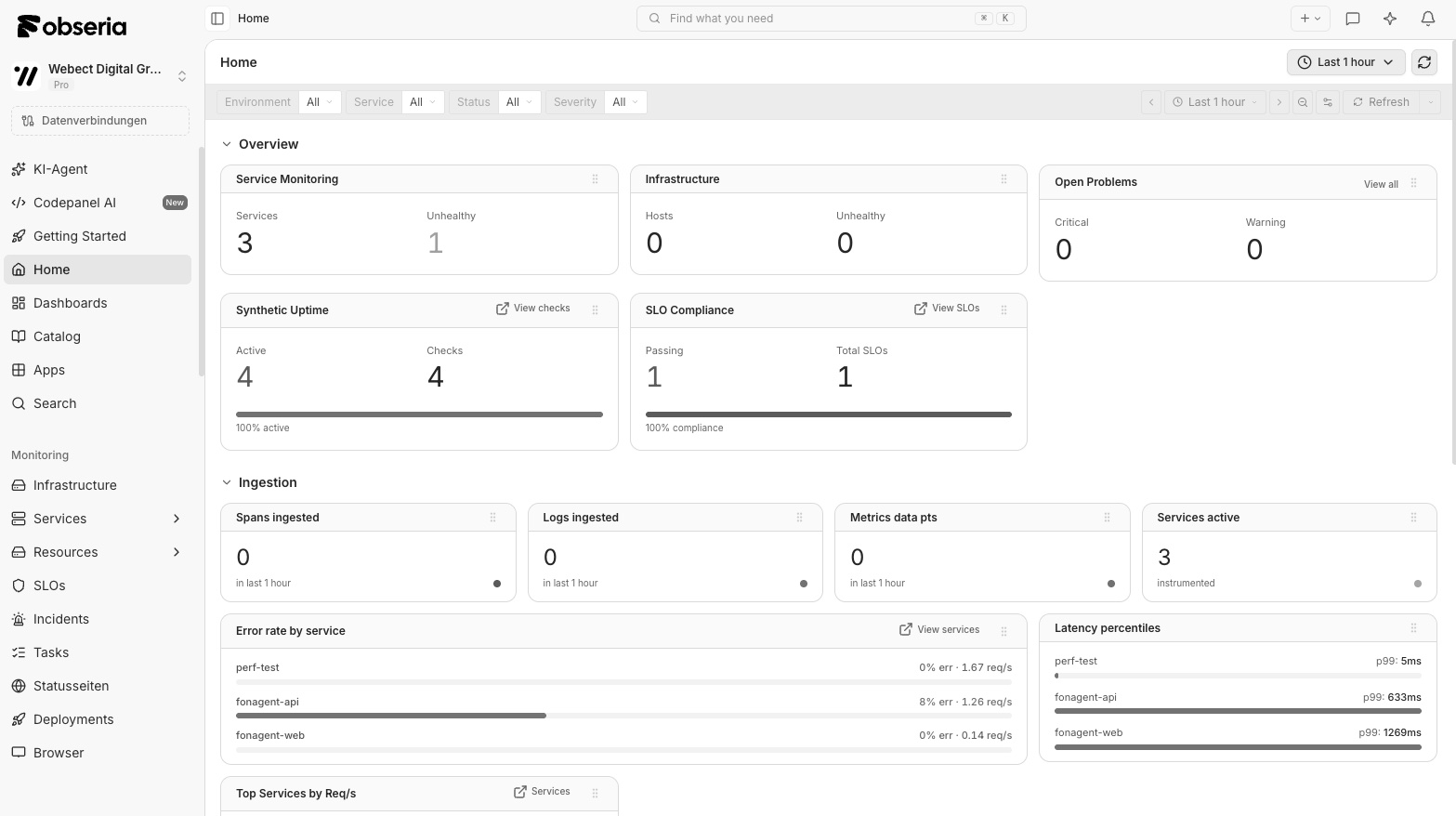
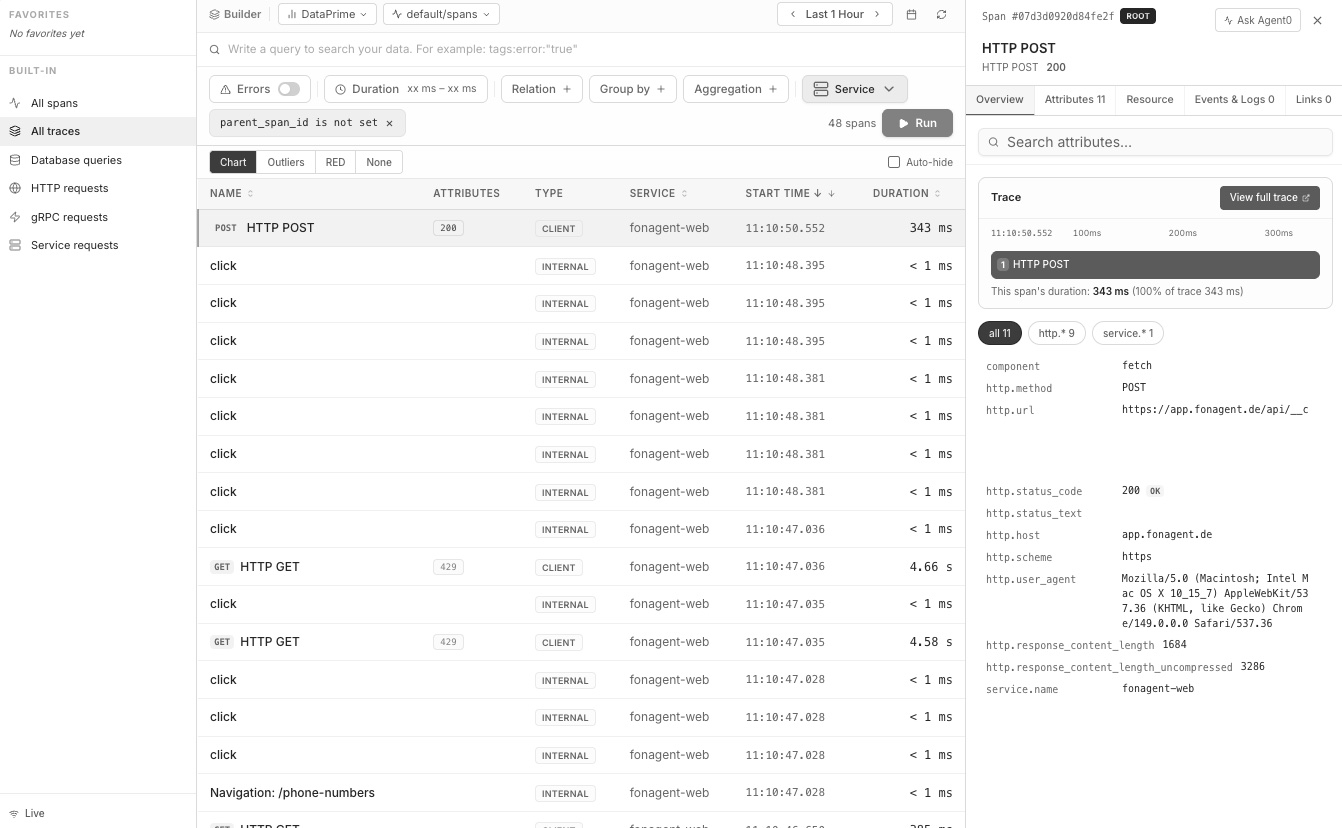














Six layers of the observability architecture
Each layer has one job and passes the full context of every signal to the next one.Ingestion
OpenTelemetry SDKs and Collector, the Obseria Agent, a Kubernetes operator and agentless APIs for 300+ AWS, Azure and GCP services.
Obseria Pipeline
Stream processing at ingest: filter noise, mask PII, enrich with Kubernetes and trace context, sample tail-based and route to buckets.
Obseria Lake
An index-free lakehouse for logs, metrics, traces, profiles and events with schema-on-read and field-level privacy at petabyte scale.
Obseria TopoGraph
Automatic, continuously updated topology of services, hosts, containers, cloud resources and deployments that gives every data point context.
Obseria Intelligence
Causal, predictive and generative AI that runs root-cause investigations with a chain of evidence instead of correlations.
Apps and automation
Dashboards, SLOs, alerting, workflows as code, API, CLI and MCP server built on the same data and topology.
Open ingestion and a pipeline that runs before storage
Obseria accepts OTLP natively, so existing OpenTelemetry SDKs and Collectors send data without proprietary agents. Where you want zero-touch coverage, the Obseria Agent is installed once per host and the Kubernetes operator rolls it out cluster-wide. Every signal then passes the Obseria Pipeline, where you decide what is kept, masked, enriched or dropped before it costs storage.
- OTLP over gRPC and HTTP, plus Prometheus remote write
- Obseria Agent for metrics, logs, traces, profiles and security signals
- Agentless integrations for 300+ AWS, Azure and GCP services
- Filter, mask, enrich, tail-based sampling and routing at ingest
- Filtered data costs only ingestion, never storage
An index-free lakehouse with built-in context
Obseria Lake stores all signals in one lakehouse without upfront indexes or rigid schemas. Fields are parsed at query time (schema-on-read), so new attributes are queryable immediately with OQL, PromQL or SQL. TopoGraph links every record to the service, host, pod, cloud resource and deployment it came from.
- No index planning, no re-indexing when log formats change
- Schema-on-read across logs, metrics, spans, profiles and events
- OQL pipe syntax, PromQL and SQL on the same data
- Field-level access control and privacy rules in storage
- Topology updated continuously from telemetry and cloud APIs
Reference architectures for Kubernetes, multi-cloud and GenAI
In Kubernetes, run an OpenTelemetry Collector as DaemonSet or gateway, enrich with k8sattributes and export via OTLP; the operator adds the Obseria Agent where you want deep host data. In multi-cloud setups, agentless cloud integrations cover managed services while one Collector gateway per region forwards workload telemetry. GenAI and LLM apps send OpenTelemetry GenAI spans for prompts, tokens, cost and quality through the same path.
- Kubernetes: Collector DaemonSet or gateway plus optional operator
- Multi-cloud: agentless APIs for managed services, regional gateways for workloads
- GenAI/LLM apps: OpenTelemetry GenAI conventions for tokens, cost and quality
- Endpoints and tokens injected via environment variables
receivers:
  otlp:
    protocols:
      grpc: {}
      http: {}
processors:
  memory_limiter: {check_interval: 1s, limit_percentage: 80}
  k8sattributes: {}
  batch: {}
exporters:
  otlphttp:
    endpoint: ${env:OBSERIA_OTLP_ENDPOINT}
    headers: {authorization: "Bearer ${env:OBSERIA_TOKEN}"}
service:
  pipelines:
    traces: {receivers: [otlp], processors: [memory_limiter, k8sattributes, batch], exporters: [otlphttp]}
    metrics: {receivers: [otlp], processors: [memory_limiter, k8sattributes, batch], exporters: [otlphttp]}
    logs: {receivers: [otlp], processors: [memory_limiter, k8sattributes, batch], exporters: [otlphttp]}
Security and privacy built into every layer
Sensitive data is handled before it is stored: the Pipeline masks PII automatically and the Lake enforces field-level access. Every query and configuration change is written to audit logs. Customer data is never used to train AI models.
- Automatic PII masking at ingest
- Field-level access control and RBAC with SSO
- Audit logs for queries, access and configuration changes
- ISO 27001/27017/27018, SOC 2 Type II, BSI C5 (EU region), TISAX
- Support for GDPR, DORA and NIS2 requirements
From signal to answer
- Step 1
Collect
OpenTelemetry SDKs, the Collector, the Obseria Agent and cloud APIs send all signals via OTLP.
- Step 2
Shape
The Obseria Pipeline filters, masks, enriches, samples and routes data before it is stored.
- Step 3
Store with context
Obseria Lake keeps every signal index-free while TopoGraph links it to services, infrastructure and deployments.
- Step 4
Answer and act
Obseria Intelligence explains root causes with evidence, and workflows trigger the fix.
Deployment options
| SaaS (EU / UK) | Bring your own cloud (BYOC) | |
|---|---|---|
| Data location | Obseria regions in Frankfurt, Dublin or London | Your own cloud account and region |
| Operations | Fully managed by Obseria, 99.95% SLA | Data plane in your account, managed by Obseria |
| Use case | Fast start, most teams and workloads | Strict data sovereignty or internal policy requirements |
| Compliance | ISO 27001, SOC 2 Type II, BSI C5 (EU region) | Data stays inside your security perimeter |
| Features | Every feature included | Every feature included |
Frequently asked questions
OpenTelemetry alone is fully supported: Obseria ingests OTLP natively from SDKs and Collectors. The Obseria Agent is optional and adds zero-touch host coverage, continuous profiling and security signals.
Data is stored without upfront indexes or fixed schemas. Fields are parsed at query time (schema-on-read), so you never plan indexes or re-index when formats change.
The Pipeline runs at ingest, before data reaches storage. Data you filter out costs only ingestion, and PII is masked before it is written.
Yes. With bring your own cloud (BYOC), data stays in your cloud account and region, while Obseria operates the platform. SaaS regions are available in Frankfurt, Dublin and London.
Yes. Obseria supports OTLP export at any time, so your telemetry is never locked into a proprietary format.
See the architecture with your own data
Send your first traces via OpenTelemetry in about 15 minutes. 14-day free trial, no credit card.