
Sensitive data scanner
Masks email addresses, IBANs, credit cards, passwords/tokens, phone numbers and IPs in telemetry at ingest, before storage.
Learn more →We use essential functions to operate this website. With your consent, we would also use services for statistics and marketing. You decide which categories you allow and can change your choice at any time via “Cookie settings” in the footer. More in our privacy notice.
Obseria Consent Management · Your choice is stored for 12 months
A data processing agreement under Art. 28 GDPR, published online as a legal text, for everyone who sends personal data in logs, traces or browser data to Obseria.
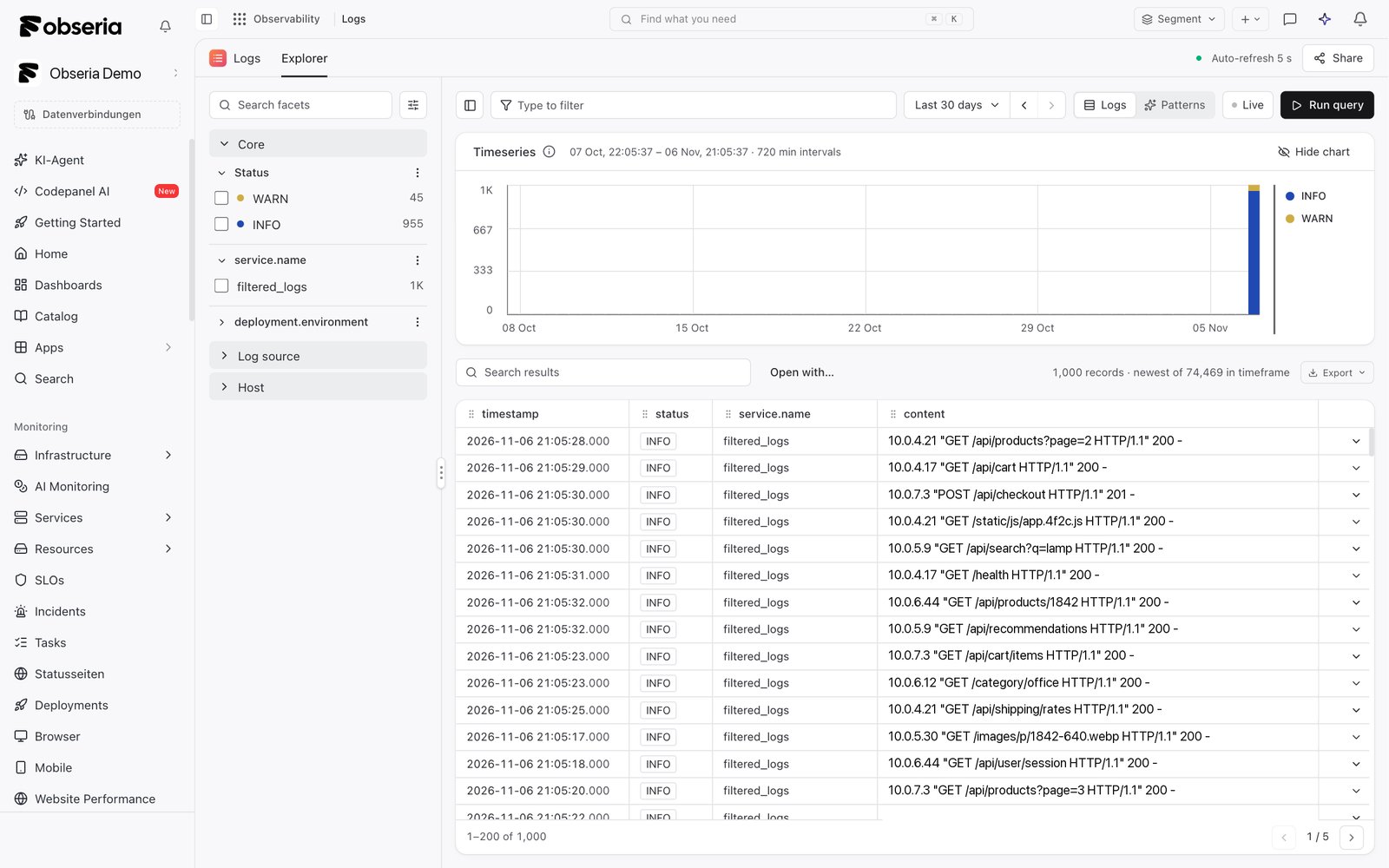
Access logs carry IP addresses and paths, error messages may carry user IDs. Facets and search show which services and fields are affected.
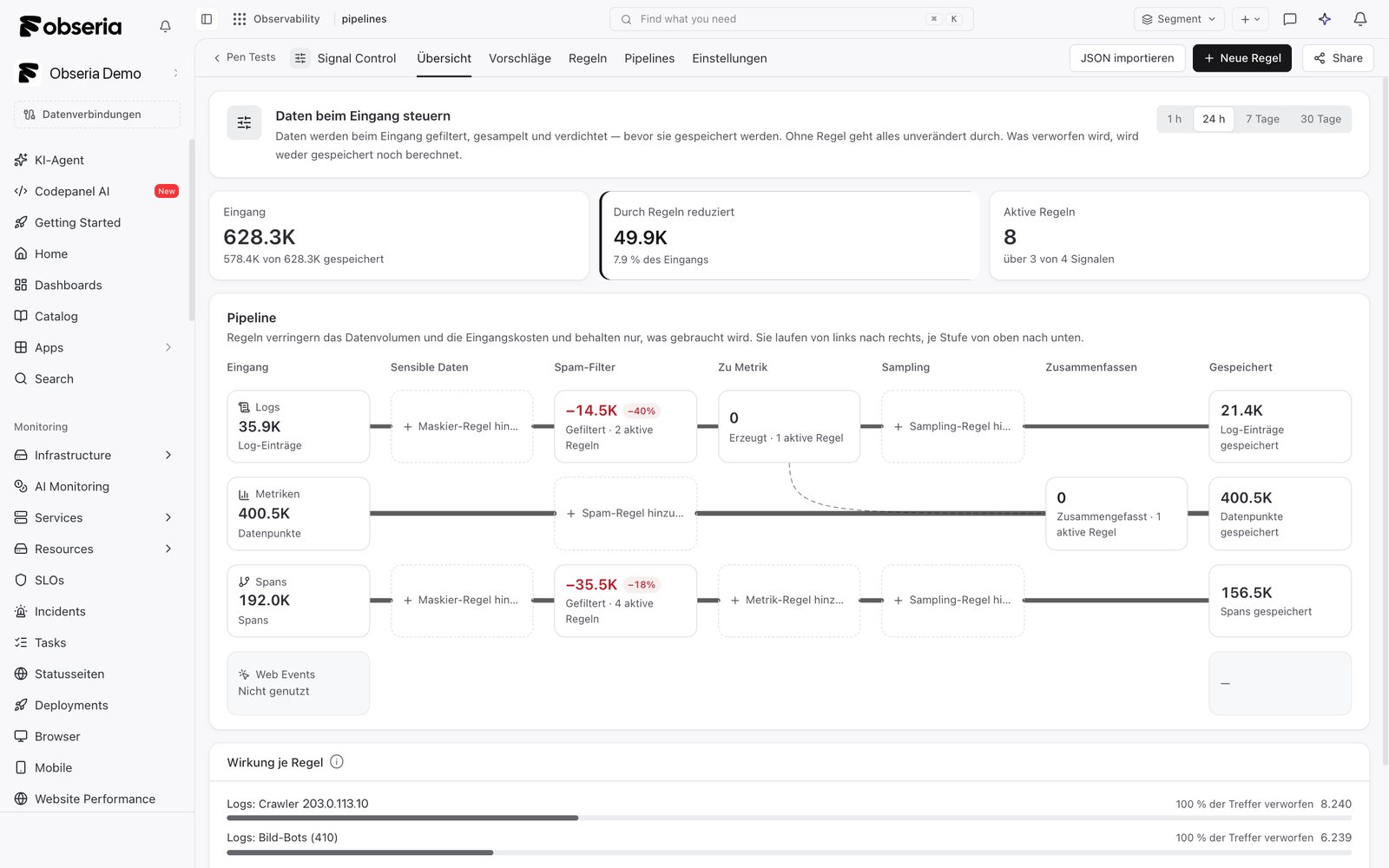
A sensitive-data stage comes first in the intake pipeline. Mask rules apply to logs and spans before filters, sampling and storage.
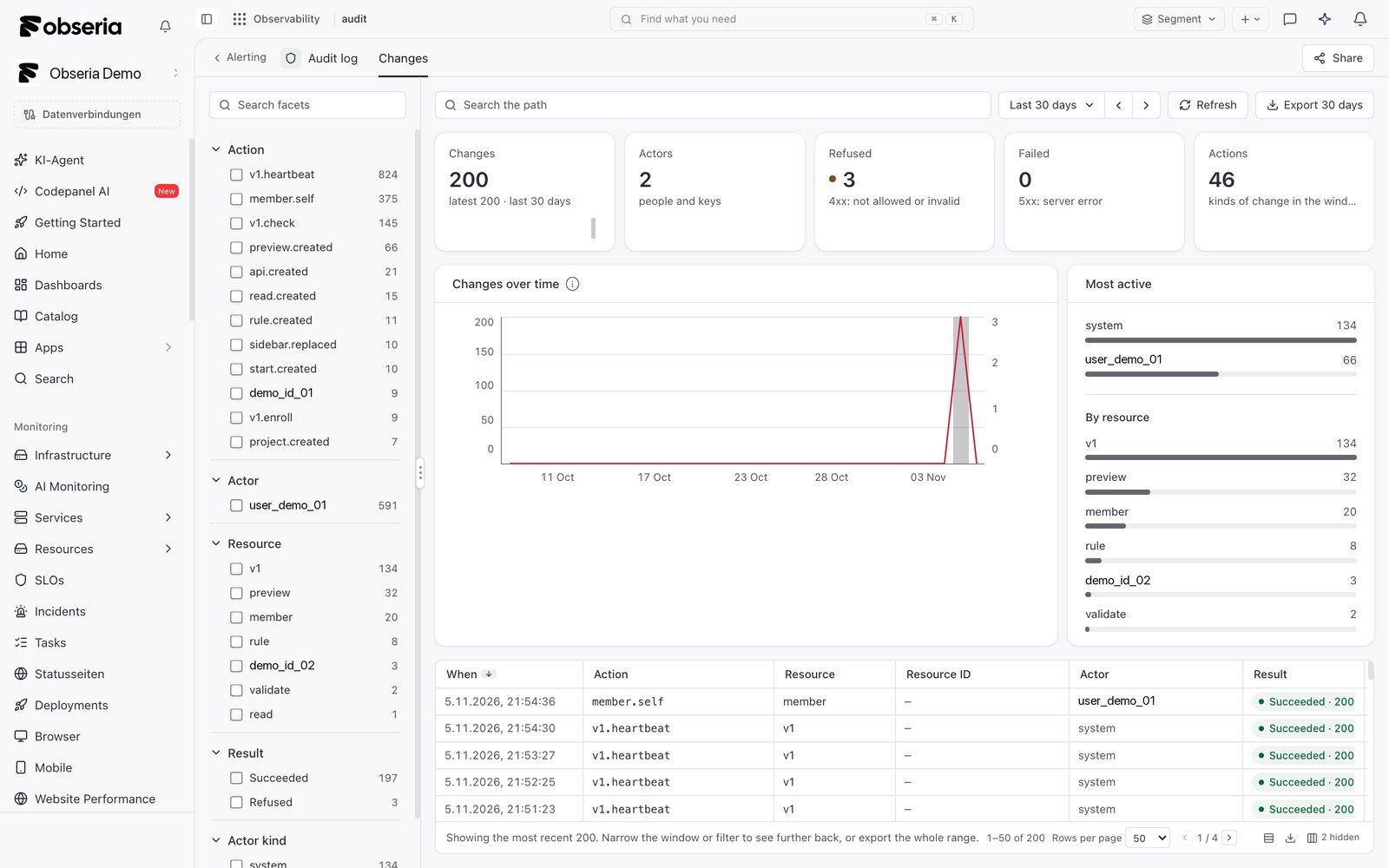
User management, access management, API keys and authentication domains for your company login, in the settings of your organization.
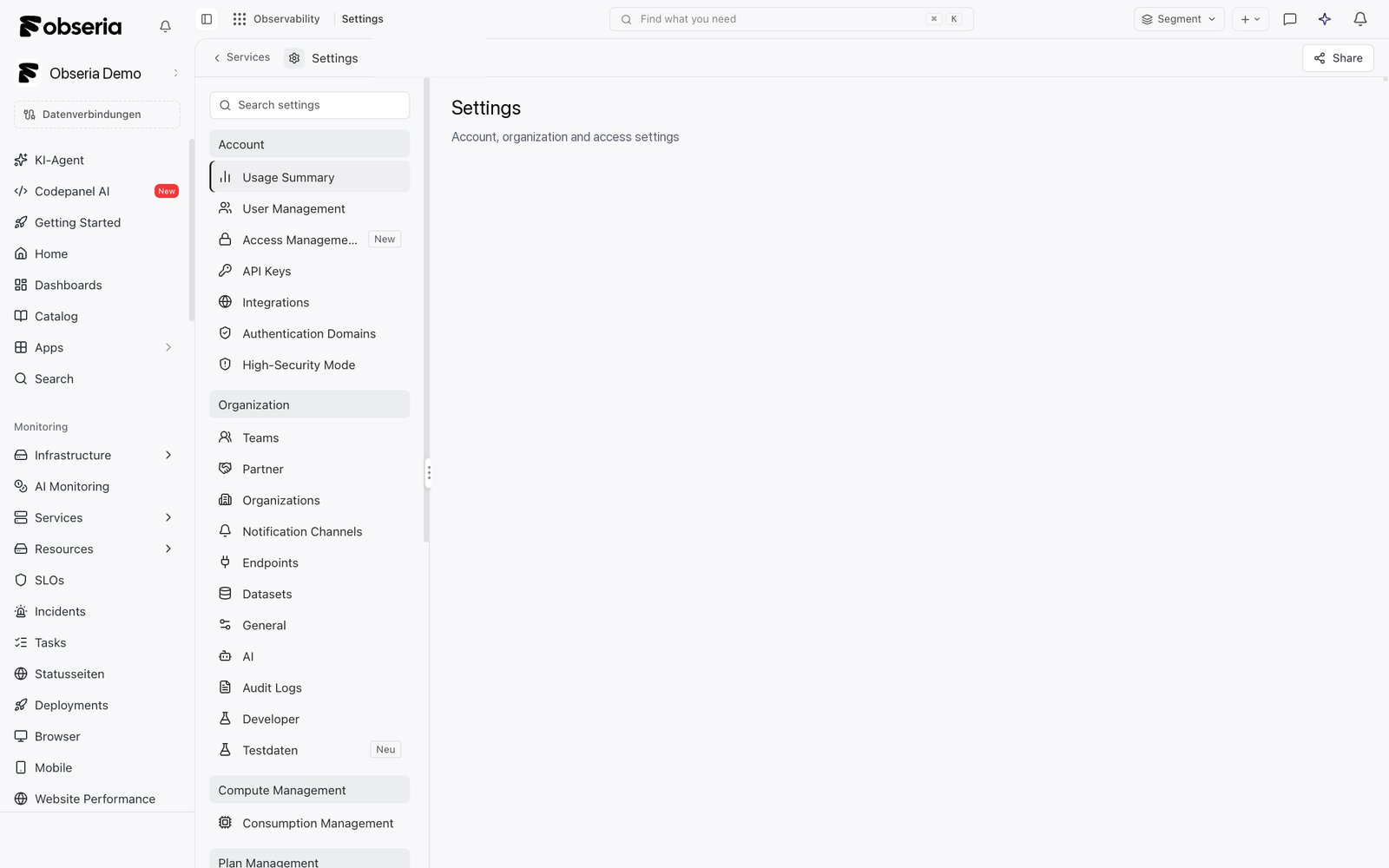
Every action with time, resource, actor and result, including refused requests, filterable and exportable for the selected period.
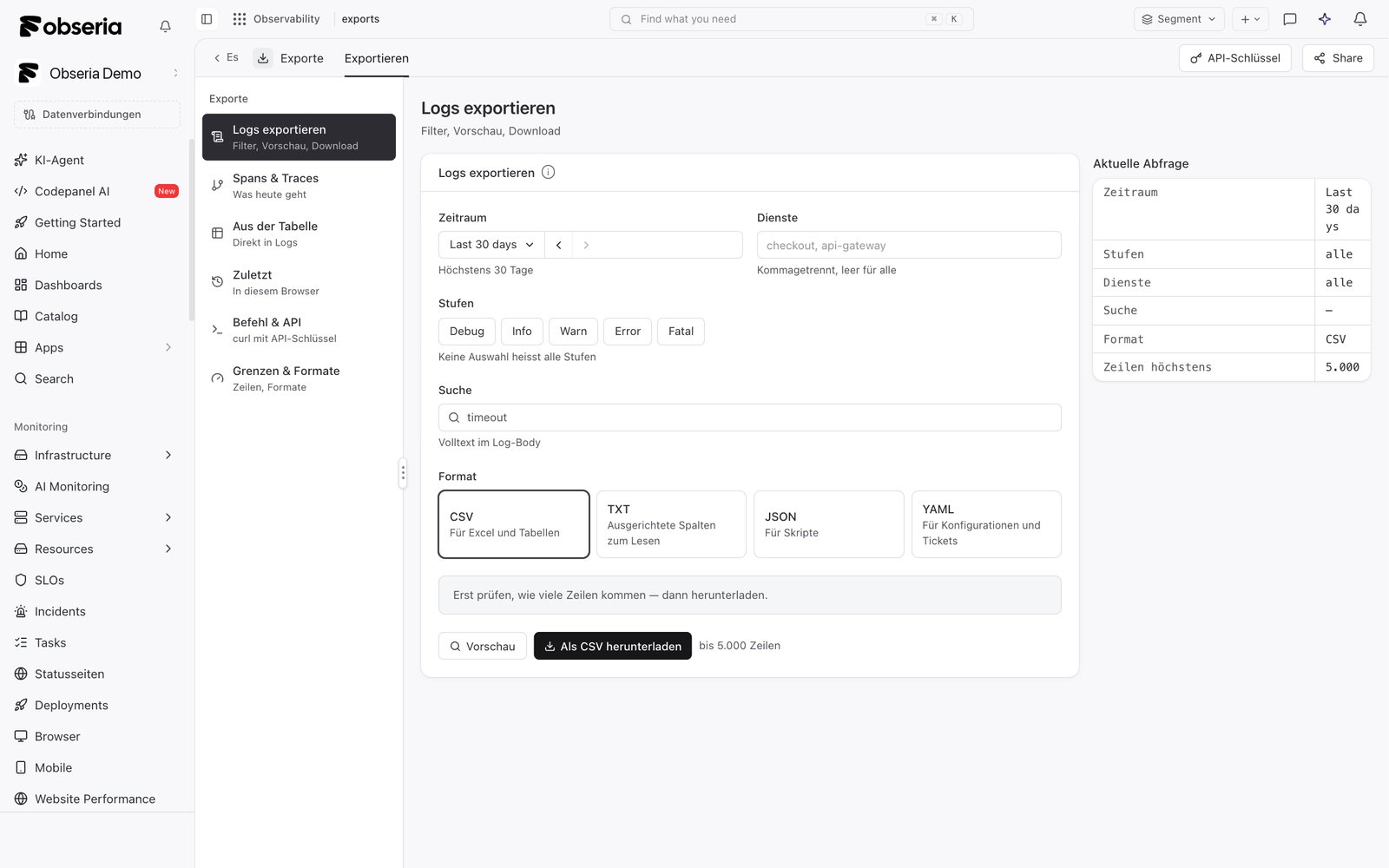
Export logs by time range, services, levels and search, with a preview first. Useful when you need to review specific data.
Masks email addresses, IBANs, credit cards, passwords/tokens, phone numbers and IPs in telemetry at ingest, before storage.
Learn more →Check which logs, traces and browser data contain IP addresses, user IDs, email addresses or free text.
Read the published DPA and the list of sub-processors with your data protection officer before you sign.
Select the data region for your organization; an EU region is available.
Let the sensitive data scanner mask what you do not need, and restrict access with roles and company login.
Add Obseria to your records of processing activities, with the DPA and sub-processor list attached.
When telemetry you send to Obseria contains personal data, you are the controller and Obseria processes that data on your behalf. Art. 28 GDPR requires a contract for this relationship: the data processing agreement.
The DPA governs what the processor may do with your data, under whose instructions, with which security measures, with which sub-processors and what happens at the end of the contract. It is relevant for everyone who sends personal data, which in practice means almost every team that sends logs or browser data.
Obseria provides this agreement as standard. You do not need to draft or negotiate your own template to get started.
The Obseria DPA is published online as a legal text, together with a list of sub-processors that names their purpose and location. Your data protection officer can review both early in the evaluation, without waiting for a sales process.
The technical and organisational measures are described in the DPA itself. Read them there and file them with your records of processing activities, so your documentation always refers to the current version.
If your organization needs to discuss specific clauses, contact us before you sign.
The DPA covers how Obseria processes your data. The simplest way to reduce risk on your side is to send less personal data in the first place. The sensitive data scanner masks email addresses, IBANs, credit card numbers, passwords and tokens, phone numbers and IP addresses at ingest, before anything is stored.
Masking is a stage of the intake pipeline, which also filters, samples and condenses data. You see per signal how much arrives, how much the rules reduce and how much is stored.
Masked values never reach storage, so they also do not appear in searches, exports or answers to AI assistants.
The data region is chosen and stored per organization, with an EU region available. Together with the DPA this answers the two questions data protection officers ask first: where is the data, and under which contract is it processed?
Inside Obseria, roles and permissions decide who can see and change what, people sign in with their company login, and the audit log records actions with actor, resource and result.
When you need to look into specific data, for example for a request from a data subject, the log explorer and filtered exports help you find and review it.
 OpenTelemetry
 OpenTelemetry Collector
 NGINX
 Kubernetes
 Linux
 Fluentd
 Browser
 Docker
A data processing agreement (DPA) is the contract the GDPR requires whenever one company processes personal data on behalf of another. The company that decides why and how the data is processed is the controller; the service provider that processes it on the controller's instructions is the processor. Article 28 GDPR says that this relationship must be governed by a contract with specific content. In German it is called Auftragsverarbeitungsvertrag, or AVV.
Without a DPA, handing personal data to a service provider is generally not permitted. That is why data protection officers ask for one before a new tool goes live, and why it should be part of every evaluation of a SaaS product that receives personal data.
It is tempting to think of monitoring data as purely technical. In practice, telemetry very often contains personal data:
As soon as any of this reaches an external observability platform, you are the controller and the provider is your processor. A DPA is then required, regardless of how large or small the share of personal data is.
Article 28 lists what a DPA must cover. In short:
A DPA covers the provider's obligations. As controller, you still have work to do:
Obseria provides a data processing agreement under Art. 28 GDPR, available online as a legal text. It is relevant for everyone who sends personal data to Obseria, which in practice means almost every team that sends logs or browser data. You can read the data processing agreement and the list of sub-processors before you sign, and pass both to your data protection officer.
The platform helps you keep your side of the work small:
More about how Obseria handles security and privacy is on the security and trust page and in the privacy notice. This page is not legal advice, and Obseria does not claim certifications here; the DPA and these features support your own GDPR documentation.
Yes, as soon as the telemetry you send contains personal data, which logs, traces and browser data very often do. You are then the controller and the provider is your processor under Art. 28 GDPR.
Yes. A data processing agreement under Art. 28 GDPR is available online as a legal text.
Yes. The DPA and the list of sub-processors are published online so your data protection officer can review them early.
They are described in the DPA itself. Refer to the current version there in your documentation.
The data region is chosen and stored per organization, and an EU region is available. The locations are named in the published list of sub-processors.
The sensitive data scanner masks email addresses, IBANs, credit card numbers, passwords and tokens, phone numbers and IP addresses at ingest, before storage. Intake rules can also drop data you do not need.
No. A DPA is one required building block. Data minimisation, access control, retention and your records of processing activities remain your responsibility. This page is not legal advice, and no certifications are claimed here.
This page does not replace the legal text: the binding content, including the technical and organisational measures, is in the DPA itself. Obseria does not claim certifications here and does not give legal advice. If you need individual clauses, talk to us before you sign.
The foundation for all products: data intake, dashboards, alerts, governance and AI access.
→The data region is chosen per organization, with an EU region available.
→Roles, permissions, company login and API keys in one place.
→How Obseria supports your own compliance documentation.
→Filter, sample and mask data at ingest, before it is stored.
→In 30 minutes we show you how Obseria works in your environment and answer your questions on setup, privacy and pricing.
