
Observability for insurance: reliable policies, claims and portals
Follow quotes, policies and claims across core systems, portals and partner interfaces, and keep the evidence that supervisors and auditors expect














DORA: what observability has to deliver
What the EU regulation expects from ICT incident handling and monitoring, and how insurers can prepare.
Read nowInsurance promises are kept in IT.
Customers expect online quotes and fast claims handling, brokers expect stable interfaces, and supervisors expect insurers to control ICT risk, incidents and third parties.Core systems meet digital channels
Policy administration, claims, billing and long-running core systems sit behind modern portals and apps, and a slow call anywhere shows up as a lost quote.
Brokers, partners and service providers
Comparison portals, brokers, assistance services and reinsurers connect through interfaces that fail quietly until a process is stuck.
Supervisory expectations rise
DORA and supervisory IT requirements such as VAIT ask for ICT risk control, incident classification and reporting, and an overview of ICT third-party providers.
Observability use cases for Insurance
From quote to claim settlement: where insurers start with Obseria.Policies and claims
Policy administration and rating
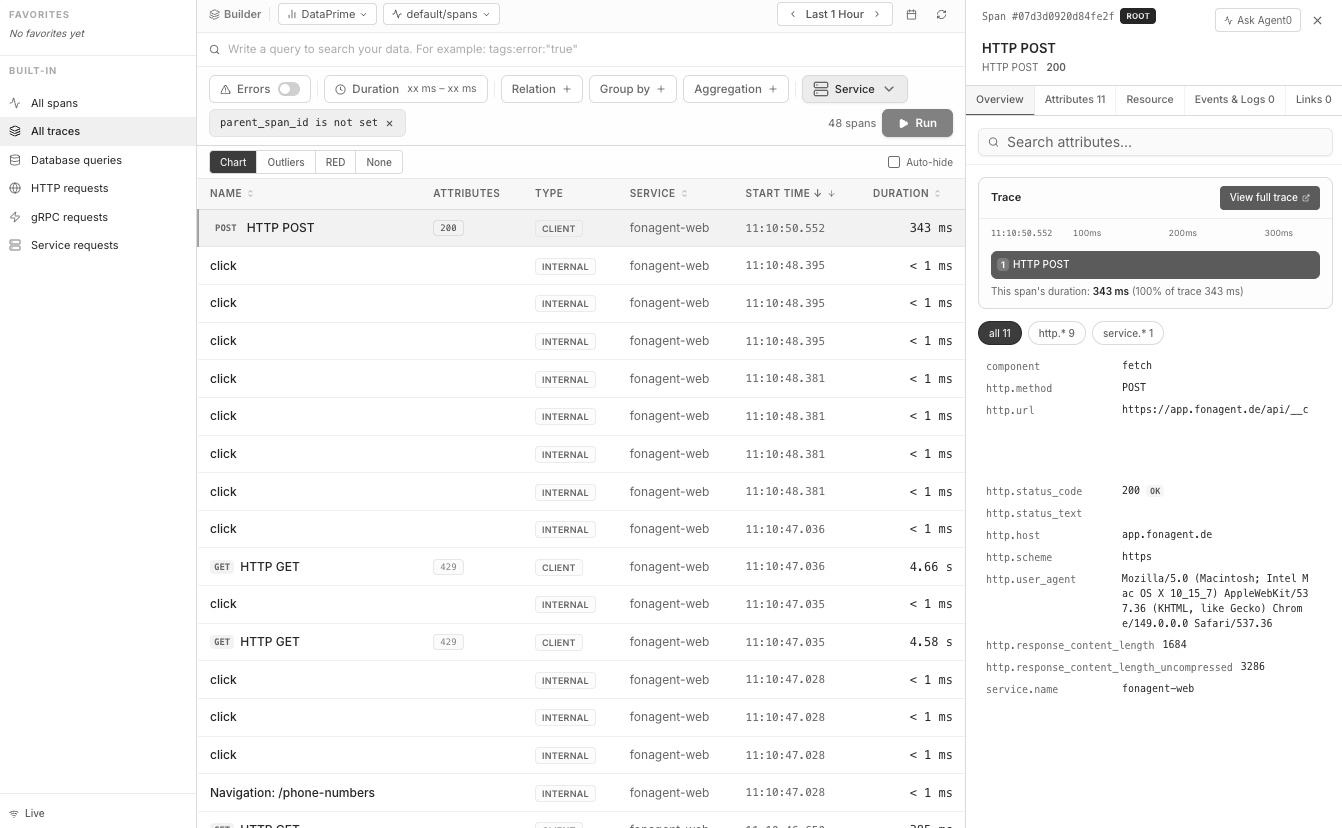
Trace quotes, policy issuance and endorsements across portals, rating services and core systems, and find the slow step behind abandoned quotes.
Application observabilityClaims intake with approvals
A claim notification arrives by e-mail or form, an AI step extracts the key fields, and claims above a threshold wait for a named approver.
Obseria WorkflowClaims and quote KPIs
Show quote-to-policy conversion, open claims and processing times next to the health of the services behind them.
Business observabilityCustomers and brokers
Customer and broker portals
Real user monitoring and synthetic checks for tariff calculators, claims reporting and broker extranets, before customers call.
Digital experiencePartner and broker interfaces
Check partner APIs and endpoints on a schedule with assertions on status and response time, and alert on errors and slow responses.
Synthetic monitoringAI agents for customer requests
An agent drafts answers to incoming requests from your company knowledge; a person checks, edits and approves before anything is sent.
Obseria AgentsRisk, security and third parties
Security monitoring with context
Detect attacks, suspicious sign-ins and vulnerabilities across applications and cloud, with the trace and log context to investigate them.
Security EnterpriseOverview of SaaS and ICT providers
Discover the SaaS apps really in use and keep data processing agreements, data locations, certificates and contract dates per vendor.
Obseria Shadow ITRegisters and reports in one place
Keep lists such as incidents or vendors in typed tables, import CSV or Excel, and answer questions with SQL or plain language.
Obseria DataEvidence for regulated insurers
Obseria does not make an insurer compliant. It supplies the monitoring data, audit trails and records that support your own ICT risk management and documentation.
- DORAIncident detection, timelines and affected services as input for your incident classification and reporting, plus records that support your overview of ICT third-party providers.
- VAIT and supervisory requirementsLogging, monitoring and access evidence for supervisory IT requirements, where they still apply alongside or before DORA.
- Audit trailWho changed what and when in Obseria, recorded for people and API keys.
- GDPRMasking of personal data such as names, policy and claim numbers before storage, and a data processing agreement under Art. 28 GDPR.
- EU data residencyThe data region is chosen per organization, with an EU region available.
Already in production use at companies
Together with our implementation partner Webect Digital Group GmbH, Obseria already monitors the systems of companies of different sizes. Webect handles rollout, integration and ongoing support, while our product team keeps developing the platform based on their feedback.
- In production use at customers
- Rollout and support by Webect Digital Group
- Personal contacts in Germany
- Product development close to customers
The Obseria platform for Insurance
Application Observability
Tracing for policy, claims and portal services.
Learn moreSecurity Enterprise
Security monitoring with full observability context.
Learn moreObseria Shadow IT
SaaS inventory, vendor compliance and contracts.
Learn moreObseria Workflow
Claims and approval processes with a full run history.
Learn moreInsurance observability FAQ
No tool can do that. Obseria supports your evidence: it detects and documents incidents with timelines and affected services, keeps an audit trail and maintains records about the SaaS vendors you use. Classification, reporting and the overall ICT risk framework remain your responsibility.
Obseria monitors everything that can be instrumented with OpenTelemetry or that sends logs and metrics, for example application servers, databases, queues and the services around a core system. Which parts of an older core system can be covered is best clarified in a short technical review.
The data region is chosen per organization, with an EU region available. Masking rules remove personal data such as names or policy numbers before it is stored.
No. Shadow IT discovers and documents SaaS use, for example from Google Workspace or Microsoft 365 sign-ins, with read-only directory connections. It does not block apps. Revoking access creates a task for the responsible person.
You decide per agent: suggest only, act after approval or act alone. For customer-facing answers, insurers usually start with approval, so every draft is checked and the decision is stored with person and time.
Keep every policy promise, and prove it.
See how Obseria connects policy, claims, portals and ICT providers in one view.